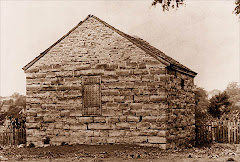
April 6th is a momentous day to members of the Church of Jesus Christ of Latter-day Saints. It was on this day 181 years ago that the Church was organized in a log cabin belonging to Peter Whitmer, Sr. at Fayette, Seneca County, New York.
The Church was organized in a way "agreeable to the laws of our country." (D&C 20:1) Six men were selected to become incorporators of the Church as required by law. Those men are Joseph Smith Jr., Oliver Cowdery, Hyrum and Samuel Smith, David Whitmer and Peter Whitmer Jr. Organizing legally was important, but it is easy for anyone to organize a church according to the law. More importantly, the Church was organized in a way agreeable to the Lord.
On April 7, 1829 Joseph received golden plates on which the prophet Mormon had abridged the ancient record of the early inhabitants of the American continent. Like the Bible, this record testifies of Jesus Christ. With Oliver as his scribe Joseph translated the plates in less than three months and the first edition of the publication called the Book of Mormon was completed in the spring of 1830. For anyone who has ever written or attempted to write a work of significant length, the speed with which the translation was completed is a witness to the miraculous work and divine intervention which made it possible. (For more information about the translation process read By the Gift and Power of God, by Elder Neal A. Maxwell) The coming forth of the Book of Mormon was a marvelous work and a wonder and key in preparing to organize the Church.
In June of 1829 Joseph and Oliver were instructed to wait for the proper time to organize and then in early April of 1830 Joseph receieved a revelation that directed him when he should organize the church.
D&C 20:1 The rise of the Church of Christ in these last days, being one thousand eight hundred and thirty years since the coming of our Lord and Savior Jesus Christ in the flesh, it being regularly organized and established agreeable to the laws of our country, by the will and commandments of God, in the fourth month, and on the sixth day of the month which is called April.
On April 6, 1830 the Church of Christ was established, restoring to the earth the same organization with prophets, apostles, pastors, teachers, evangelists and so forth, that existed in Christ's church. Amos taught that "Surely the Lord God will do nothing, but he revealeth his secret unto his servants the prophets." (Amos 3:7) Once again, a prophet holding the keys of priesthood government was set in place to lead the people in accordance with the Lord's will and desires.
April 6th was absolutely a momentous day. During the events of this Church organization and Gospel Restoration, many who were present followed the Savior's example. Just as Jesus was baptized by immersion by an authorized priesthood holder, many in attendance chose to be baptized by those holding the restored priesthood authority from God. The Sacrament was administered to the baptized members and they received the Gift of the Holy Ghost. April 6th was a marvelous and historic day.
As an interesting side note, there is some diputation among memers of the church about whether or not April 6 is also the true birthday of Jesus Christ. I won't go into details of the arguments for or against, but you might check out these links if you are curious.
http://www.johnpratt.com/items/docs/lds/aprilsixth.html Defense of April Sixth by John Pratt http://www.mormonfortress.com/april6b.html Mormon Myths-April 6 Michael R. Ash http://www.lightplanet.com/mormons/basic/christ/april6.html by John Franklin Hall
While this debate is interesting, the exact date of the Savior's birth doesn't really matter to me all that much. I don't mean to be ambivalent about His birth, in fact I feel quite the contrary. To me personally, the significant fact is not the exact date of His birth, but rather the fact that He was born. The fact that He is the Son of God. The fact that He is the Savior and Redeemer. The fact that through His atoning sacrifice of pain and death all mankind can be saved through faith in Him and His tender mercy and grace. The fact that Christ restored His church through the prophet Joseph Smith. Knowing the "when" doesn't concern me nearly as much as knowing and believing the "who" the "how" and the "why". These questions are all answered through the Gospel of Jesus Christ.
So--Happy Birthday Church!
*The official name of the Church was changed to The Church of Jesus Christ of Latter-day Saints on April 26, 1838 according to a revelation received at Far West, Missouri. (D&C 115:4)